
Taylor Swift vs. The Anglerfish
A data story about fame, curiosity, and the politics of which species we save.
TL;DR
- In 2025, a black seadevil image drove a sharp, but short-lived, spike in public attention.
- For four days, the anglerfish Wikipedia page outperformed Taylor Swift's.
- The deeper question is whether that fascination could translate into lasting conservation interest.
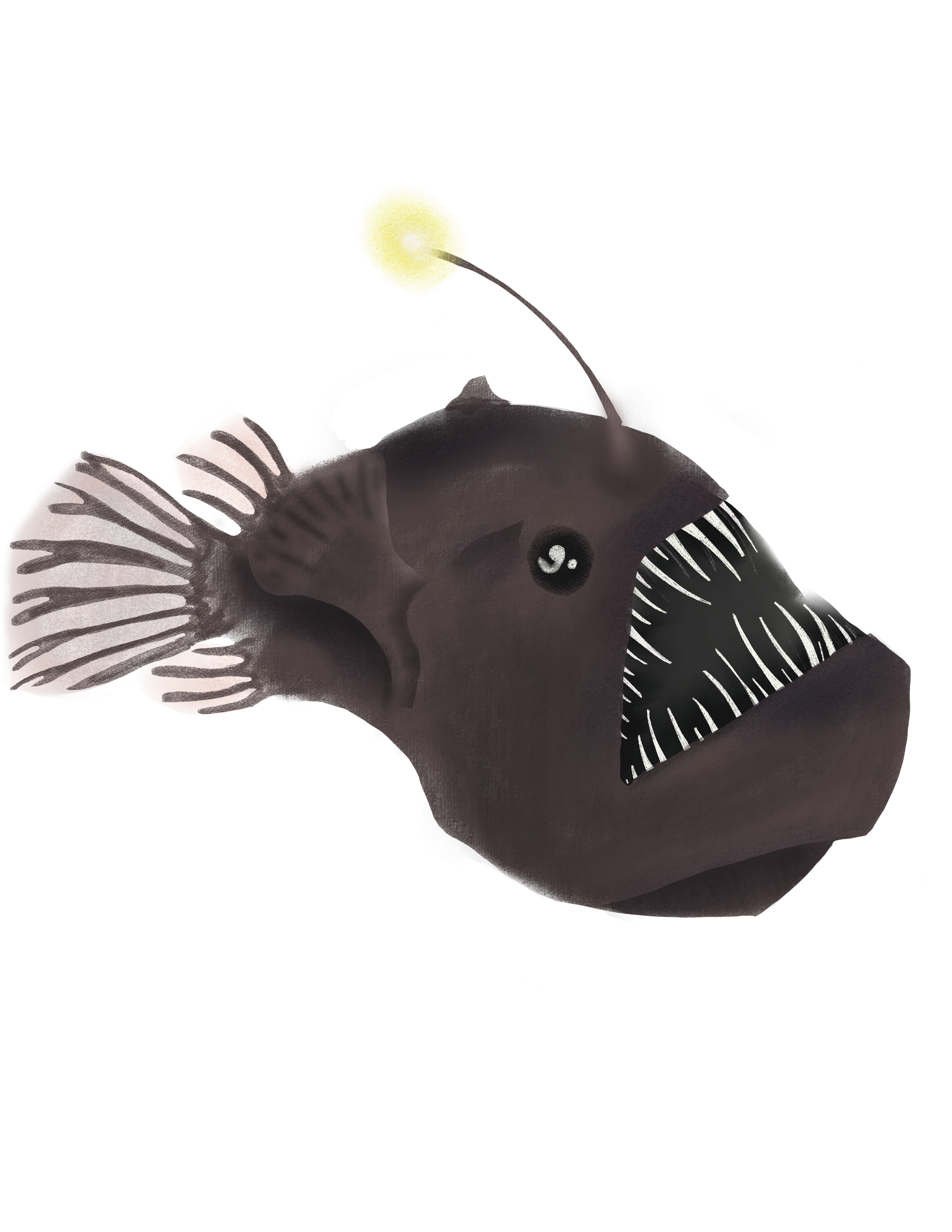
In 2025, a deep-sea anglerfish known as a black seadevil captured the hearts of people around the world when an organization called Condrik Tenerife released a rare image of the species taken off the coast of the Canary Islands. The photo spread rapidly across social media and news outlets, transforming one of the ocean's most elusive predators into an unlikely internet celebrity.
Part of what made the image so arresting is that black seadevils are typically documented between roughly 100 to 4,500 meters, making her very far from home, indeed. When she captured global attention, it made me wonder: does viral marine imagery actually translate into real-world conservation and protection?
The first thing I did was turn to data. Using the Wikimedia Pageviews Analysis tool (pageviews.wmcloud.org), I pulled three years of traffic data for the "Anglerfish" Wikipedia page. In the chart below, days are plotted along the x-axis and Wikipedia pageviews are along the y-axis. It only takes a quick glance to see the surge of interest that this single photo caused. At its peak, the Anglerfish Wikipedia page was visited 38,444 times in a single day.
The Black Seadevil Pageview Surge
Figure 1.A visual impression of the anglerfish attention spike that followed the viral 2025 black seadevil image.
Ok, so there was a surge in page views. What does that mean? 38,444 feels like a very big number, but maybe it's just a tiny blip compared to other commonly searched things.
How does this compare to page views for other animals? Other popular things? So I did what any curious journalist would do. I compared our anglerfish to the most universally popular topic I could think of: Taylor Swift.
This comparison helps me with two things:
- It provides a baseline for interpreting scale, putting the anglerfish spike into perspective.
- It helps me to understand whether the anglerfish spike was culturally significant, or statistically trivial.
Initially, we see that Taylor Swift's pageviews massively overwhelm that of the anglerfish. But when we zoom in to the anglerfish spike, we see a shocking upset. On Feb 14th, 15th, 16th, and 17th, the anglerfish's Wikipedia page actually overtook Taylor Swift's.
Taylor vs. Fish
Figure 2.Comparative daily Wikipedia pageviews for Anglerfish and Taylor Swift, showing the four-day interval in February 2025 when anglerfish attention briefly exceeded Taylor Swift.
Here is the data for the days our angler beat out Taylor. The streak begins, somewhat poetically, on Valentine's Day 2025. The biggest upset occurs the very next day, February 15th. The anglerfish holds the lead for four days before dropping back down to something much closer to its average, almost as quickly as the spike began.
Table 1.Daily Wikipedia pageviews for Anglerfish and Taylor Swift from February 14 through February 17, 2025, with the absolute difference between the two articles.
| Date | Anglerfish | Taylor Swift | Difference |
|---|---|---|---|
| Feb 14, 2025 | 30263 | 28543 | 1720 |
| Feb 15, 2025 | 38444 | 28869 | 9575 |
| Feb 16, 2025 | 34278 | 24995 | 9283 |
| Feb 17, 2025 | 26988 | 21267 | 5721 |
This is enough for me to assume that this was a culturally significant event. What I was really wondering in all of this is whether it will actually help the black seadevil be conserved now that one of them has become a famous icon. This is where the conversation becomes much more nuanced.
To explore that, I wanted to compare her popularity spike to that of other "charismatic species." In conservation ecology, "charismatic" has a very specific meaning. These are the species that attract disproportionate funding and public support for conservation projects. Things that humans tend to think are cute, or majestic - think lions, penguins, panda bears, etc.
Everyone wants to save the tiger, but nobody is launching fundraising campaigns for the obscure, but critically-endangered beetle that happens to live in the same forest. That said, protecting the tiger's habitat can indirectly protect that beetle too, especially if funding is directed toward preserving the ecosystem as a whole.
Who Gets to Be Charismatic?
A 2018 paper1 identified the top charismatic animals based on different traits, like rarity, aesthetics, and, well, charisma. Of the top 20, four were marine animals. Three of those four had sufficient Wikipedia pageview data for comparison: the blue whale, the polar bear, and the great white shark. (Dolphins were included in the original list, but the pageview data was too inconsistent to use here, so they were excluded.)
Now there is something you may notice about this list of species: they are all LARGE. The blue whale is literally the largest animal (as formally defined) that has ever existed on the planet.
Being large is not a requirement for being characterized as charismatic. Nobody formally decides who the charismatic species get to be, per se; it's an informal title bestowed collectively by human preference, and organizations would be smart to request funding based on the most beloved animal in the habitat they're trying to protect.
Still, it is rather rare for a small, weird animal to be considered a "charismatic" species or an "ambassador" species. They are normally large vertebrates that we can somehow anthropomorphize. In the black seadevil's case, people just simply seem to be attracted to her weirdness. For example, the female uses what is essentially a bioluminescent "fishing pole" on the top of her head to attract prey. Male anglerfish simply attach to her, fuse with her body and function as parasites for the rest of their lives. She has very, very large teeth for her tiny body, and just generally looks a bit terrifying.
That's what makes this surge of interest so fascinating. Does she have what it takes to become a charismatic species?
The next graph shows the same anglerfish spike from the first chart, but this time with the other three charismatic marine species added in for comparison. The other prominent peak you're seeing corresponds to International Polar Bear Day in 2024. I couldn't find another event that made that particular year stand out, so I'm tentatively attributing it to effective marketing rather than ecological urgency.
The Company She Keeps
Figure 3.Three-year Wikipedia pageview comparison across Anglerfish, Blue whale, Great white shark, and Polar bear, showing both baseline disparity and episodic spikes in attention.
I averaged out the views for each species over the last three years, and even with its big ol' viewing streak, the anglerfish still comes in below polar bears, white sharks, and blue whales. This is unsurprising, given the general disinterest in anglerfish during the rest of recorded internet history. Still, I thought a better comparison might be a pound-for-pound analysis, since it's so rare for something so tiny to somehow end up as ambassador species.
In other words, given how small the black seadevil is, how much attention was it able to generate relative to its size?
The maximum weight of the other 3 animals was easy to find. However, I wasn't able to locate a reliable maximum weight for a black seadevil, so I gave a very, very conservative estimate. If you have ever seen a photo of one next to something with a relative scale, they are much smaller than expected. They could easily fit in the palm of your hand, and that scale is part of what makes the animal so absurdly compelling. Adult females reach only about 18 centimeters (although they can still swallow prey larger than their own bodies).
Very conservatively, I'd estimate that with a maximum size of roughly eight inches, female black seadevils cannot weigh more than two pounds soaking wet (which, hopefully, they normally are). Would I personally guess less than a pound? Probably. But we are scientists. And we speak conservatively. So for the sake of this visualization, we'll say the maximum weight of a black seadevil is approximately 2 lbs.
When you convert the data to pound-for-pound "punching power" (average views over the last three years divided by the maximum weight of each animal) you get a very different picture, as shown here.
Animal Size in Pounds
Table 2.Maximum weight assumptions and three-year average daily Wikipedia pageviews used in the pound-for-pound comparison of marine charismatic species.
| Species | Weight (lbs) | Average Daily Views | Days |
|---|
The blue whale, largest animal in Earth's history, generates less than one hundredth of a view per pound.
The anglerfish?
Nearly 924 views per pound.
That means pound-for-pound, the black seadevil generates:
- ~512x more attention per pound than a polar bear
- ~1,860x more than a great white
- ~120,000x more than a blue whale
Figure 4.Relative body-mass comparison for the four species in the analysis, scaled by approximate maximum weight in pounds.
That does not mean the anglerfish suddenly became the ocean's new enduring celebrity. It means something narrower, but still important: under the right conditions, even a small and unfamiliar animal can command an extraordinary amount of public attention. The harder question is what survives once that attention collapses back to baseline.
Let's Play a Game...
Is There A Relationship Here?
Poll: Take a look at the above chart, and make a guess. Is there a relationship between these two things?
What Remains After the Spike
So let's return to the original question. Is an anglerfish more charismatic than Taylor Swift? Clearly not. But for four days in February 2025, more people were curious about an anglerfish than reading Taylor Swift's biography, and that brief reversal says something real about how quickly public attention can flare around a species most people would otherwise never notice.
Most viral moments disappear as fast as they arrive. They do not automatically become policy, protection, or long-term care. But they can open a small window. They can give people a reason to look more closely at a place they have ignored, or to care about an animal that would otherwise remain abstract, invisible, and far below the surface.
If even a fraction of that curiosity sticks, then the spike mattered. Not because the anglerfish became more famous than a pop star, but because for a brief moment the deep sea forced its way into public attention. Sometimes that is where change starts: not with certainty, but with fascination strong enough to make people keep looking.
Methods
Data Sources
Wikipedia pageview data were obtained using the Wikimedia Pageviews Analysis tool provided by the Wikimedia Foundation (https://pageviews.wmcloud.org/). The tool provides daily counts of visits to individual Wikipedia articles based on publicly available server logs.
Pageview data were collected for the following English-language Wikipedia pages:
- Anglerfish
- Taylor Swift
- Blue whale
- Great white shark
- Polar bear
Daily pageviews were exported as CSV files and analyzed outside the platform.
Date Range
The primary dataset covers January 1, 2023 through February 19, 2026, yielding 1,146 daily observations for each page.
This time window was selected to provide:
- Multiple baseline years prior to the February 2025 event
- Sufficient post-event data to observe whether interest returned to baseline
Viral Event Identification
The analysis focuses on a spike in pageviews occurring in mid-February 2025, corresponding to the viral circulation of a photograph of a deep-sea black seadevil anglerfish recorded near Tenerife in the Canary Islands by the marine research group Condrik Tenerife.
Peak traffic occurred on:
- February 15, 2025 - 38,444 pageviews
The event window was defined as the four-day period during which anglerfish pageviews exceeded those of Taylor Swift:
- February 14, 2025
- February 15, 2025
- February 16, 2025
- February 17, 2025
Comparative Attention Analysis
To contextualize the anglerfish spike, pageview counts were compared with those of Taylor Swift as a baseline measure of high internet attention.
This comparison provides a scale reference for interpreting the magnitude of the anglerfish spike relative to a consistently high-traffic topic.
Charismatic Species Comparison
To examine how attention to the anglerfish compares with well-known conservation icons, three marine charismatic species were included in the analysis:
- Blue whale
- Great white shark
- Polar bear
These species were selected based on the "charismatic megafauna" framework described in:
Albert, C., Luque, G., & Courchamp, F. (2018). The twenty most charismatic species. PLoS ONE 13(7): e0199149.
Dolphins were considered but excluded because the retrieved Wikipedia pageview series was irregular and not consistently comparable across the full study period.
Average daily pageviews were calculated across the full study period for each species.
Pound-for-Pound Attention Metric
To explore whether smaller animals can generate disproportionate public interest, a simple "attention density" metric was calculated:
Maximum weights were drawn from widely reported biological estimates:
Table 3.Maximum weight assumptions referenced in the views-per-pound calculation described in the methods.
| Species | Approx. Maximum Weight |
|---|---|
| Blue whale | ~400,000 lbs |
| Great white shark | ~5,501 lbs |
| Polar bear | ~1,760 lbs |
Because reliable weight data for black seadevil anglerfish are scarce, a conservative estimate of 2 pounds was used based on maximum reported body length (~8 inches). This estimate likely overstates the true mass of the species, making the resulting views-per-pound estimate conservative.
Data Processing
All datasets were exported as CSV files and analyzed using standard time-series visualization and aggregation methods. Analyses included:
- Daily pageview comparisons
- Three-year average pageviews per species
- Peak event identification
Charts were rendered using interactive web visualization tools to allow zooming, hover annotation, and species filtering.
Limitations
Wikipedia pageviews measure public curiosity, not conservation outcomes. A spike in search activity does not necessarily translate into funding, policy change, or ecological protection.
Additionally, the pound-for-pound attention metric is an illustrative heuristic rather than a formal ecological measure.
All analysis and visualizations were produced by the Museum of Ocean Science using publicly available Wikimedia data.
Citations
- Albert C, Luque GM, Courchamp F (2018). The twenty most charismatic species. PLoS ONE 13(7): e0199149. https://doi.org/10.1371/journal.pone.0199149
- Wikimedia Foundation (n.d.). Pageviews Analysis. Wikimedia Cloud Services. https://pageviews.wmcloud.org/
- Wikipedia contributors (n.d.). Polar bear. Wikipedia, The Free Encyclopedia. https://en.wikipedia.org/wiki/Polar_bear
- Wikipedia contributors (n.d.). Blue whale. Wikipedia, The Free Encyclopedia. https://en.wikipedia.org/wiki/Blue_whale
- Wikipedia contributors (n.d.). Great white shark. Wikipedia, The Free Encyclopedia. https://en.wikipedia.org/wiki/Great_white_shark